Key Points
- In 2022, the Tennessee General Assembly passed legislation requesting the Tennessee Advisory Commission on Intergovernmental Relations (TACIR) to conduct a study on the overall effect of utility scale solar energy development.
- The draft report was published at the June 2023 meeting, with the final report scheduled to be reviewed and approved in September of 2023.
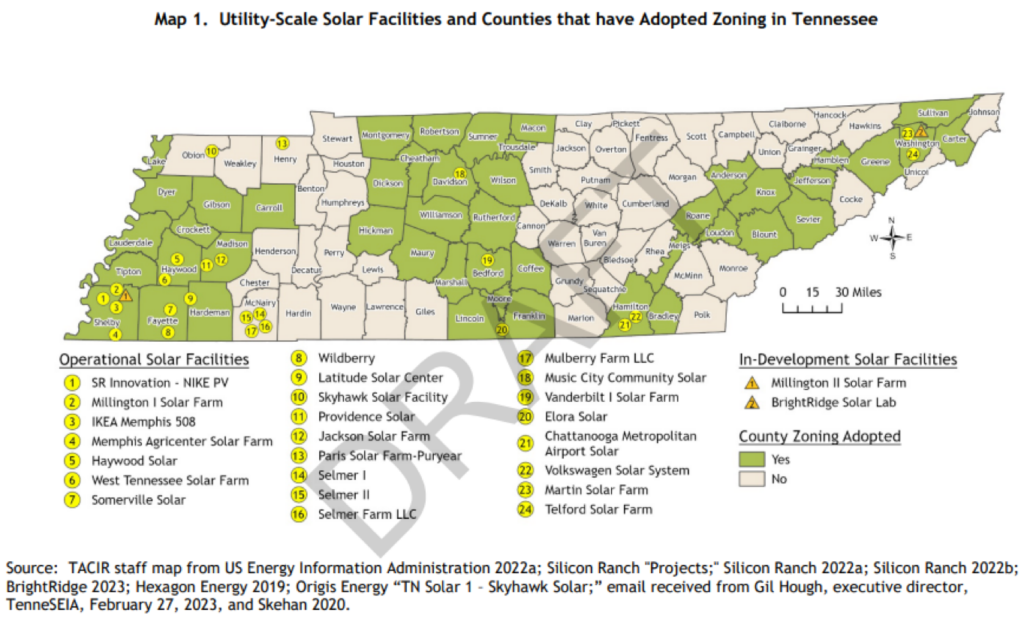
- Local governments also have a role to play in the discussion surrounding solar development and expansion. Of the 26 operational and in development solar facilities in Tennessee at the time of the draft study, 18 are in counties which have adopted zoning.
Questions
- Should legislative action be taken to limit the development of solar energy in Tennessee?
- Does your county have zoning restrictions for solar development?
Background
A TACIR study investigates questions posed in the enacting legislation, as well as makes recommendations for action based on their findings. These recommendations are submitted to the General Assembly where members can decide whether action should be taken legislatively. TACIR made three recommendations in this draft report:
- The TDEC Office of Energy Programs continue to expand and maintain their existing website with additional guidance and resources on utility-scale solar for local governments, landowners, developers, and the public.
- The TDEC Office of Energy Programs continue to expand and maintain its webpage which provides guidance and resources on residential solar for the public.
- The State should consider raising the penalty for violations of the Consumer Protection Act if the good or service involved has a value greater than a monetary threshold set by the state. The Commission recognizes care would need to be taken to avoid undermining the intent of the General Assembly’s past efforts at tort reform.
Discussion points for the study included zoning authority of local governments, consumer protection for residential solar, and the concern farmland loss plays into the introduction of utility scale solar in an area. Tennessee Farm Bureau, as well as multiple other stakeholders, provided feedback and information relative to the rate at which Tennessee is losing farmland and expressed our concern on the effects large solar development may have on prime farmland in rural areas, areas which are also prime land for solar installations. The study sites Tennessee Valley Authority’s goal of adding 10,000 megawatts of solar power generation by 2035 throughout its service area, but notes TVA’s service area covers six other states aside from Tennessee. TACIR claims even if all facilities were located on Tennessee farmland, it would account for approximately 100,000 acres being taken out of production, “only 1% of farmland in the state”. To alleviate the impact, the study suggests the use of dual-use solar or agrivoltaics, which are facilities built with solar panels raised higher above the ground, leaving room underneath to graze small ruminants like sheep or raise shade tolerant specialty crops such as tomatoes or blueberries.
Local governments also have a role to play in the discussion surrounding solar development and expansion. Implementing zoning ordinances could define the parameters which a solar facility could operate. Currently, 46 of Tennessee’s 95 counties have adopted zoning. Of the 26 operational and in development solar facilities in Tennessee at the time of the draft study, 18 are in counties which have adopted zoning. Thus far, nine counties, Bedford, Fayette, Franklin, Greene, Hardeman, Haywood, Jefferson, Sullivan, Washington, and the city of Brownsville all have used zoning authority to set standards for utility-scale solar development. TACIR staff have compiled a few counties zoning resolutions in the draft report’s appendix, which can be found by scanning the QR code.
Where do we go from here? It is expected TACIR will present their final report for approval in September and subsequently send a copy of the final report to the legislature for review. From there, it will be up to the General Assembly to decide whether to introduce legislation which matches the recommendations of the TACIR report, or if separate legislation will be considered. Farm Bureau continues to work with the original sponsors of the legislation asking for the TACIR report on what subsequent steps should follow the final draft being filed.
In July of 2023, The University of Tennessee completed a study in collaboration with the Tennessee Solar Energy Industries Association called “Evaluating Potential Land Use of Utility-Scale Photovoltaics (Solar Panels) on Farmland in Tennessee”. Scan the QR code to view this study.

Policy
Tennessee Farm Bureau Energy (Partial)
Our economic well-being hinges upon our energy cost. The United States needs an energy policy that emphasizes expanded production of all forms of energy, including nuclear and hydrogen energy and the development of new forms of energy. Conservation alone is not the solution to our energy problem.
Market demand for energy will provide incentives for increased energy production and expanded research efforts. However, in the absence of truly competitive energy markets effective government regulations of price and terms are a necessity.
Impractical regulations at all levels of government create additional energy costs and discourage the development of energy sources. Environmental impact studies for new energy developments should account for the potential irreversible loss of productive agricultural land.
We support nuclear energy as a clean, safe, and affordable energy source. The United States must be realistic as we chart a course to guarantee future generations a self-sufficient energy supply. Environmental concerns, land area and lack of technology are just a few of the shortcomings preventing coal, solar and wind energy from being reliable sources of energy. The United States should be aggressive in research and development and expansion of our nuclear energy capabilities.
Renewable Fuels (Partial)
We endorse the “25 x ’25 vision” of Agriculture’s Role in Enduring US Energy Security which reads: “Agriculture will provide 25 percent of the total energy consumed in the United States by 2025 while continuing to produce abundant, safe and affordable food and fiber.
While a variety of renewable energy resources, including wind, hydro, solar, and geothermal, will be needed to meet this goal, we are particularly interested in the utilization of biomass from agriculture and forestry.
American Farm Bureau 402 / Energy
- Solar Energy
11.1. We support:
11.1.1. Solar energy generation as a component of the nation’s energy portfolio;
11.1.2. Establishment of state standards for commercial solar energy conversion systems that protect private property rights and allow for reasonable development of projects;
11.1.3. Ensuring adequate funds are in place for decommissioning;
11.1.4. Allowing landowners the option of terminating a solar lease agreement if solar panels fail to produce energy for a period longer than 12 consecutive months; and
11.1.5. Efforts to locate solar energy projects on marginal or underused lands.
11.2. We oppose giving public utility status to solar energy or solar energy development companies.