

Yes On 2 / Senate Joint Resolution No. 1
As proposed, this constitutional amendment would prohibit the state of Tennessee from ever collecting a statewide property tax. This tax, which has not been collected since the 1940s, is separate from local government property taxes. This legislation passed in the 113th and 114th General Assemblies with the required simple majority and supermajority votes. The vote now moves to the 2026 Gubernatorial ballot where half of those voting for Governor must support the amendment for it to be codified in the state’s Constitution.
Tennessee Farm Bureau has launched a coalition known as Yes On 2 alongside Tennessee REALTORS®, Tennessee Chamber of Commerce, National Federation of Independent Business, Americans for Prosperity, and the Beacon Center of Tennessee to support the passage of this amendment. 64% of Tennessee voters support this amendment, and Farm Bureau is committed to this effort which would allow farmers to grow and support our state’s agricultural economy.
READ: TFBF Launches Yes On 2 Coalition
READ: Yes on 2 Announces Leadership Team Representing All 95 Counties
Farmland Preservation Act of 2025 | Public Charter 470
Passed in 2025 by the Tennessee General Assembly, the Farmland Preservation Act provides $25 million to the Tennessee Department of Agriculture to create a grant program allowing farmers to participate in voluntary programs to protect their productive farmlands.
TDA – PLAN
Farm Bureau is committed to seeing the future of the Farmland Preservation Fund and works closely with the TDA to ensure that the rules set on this program benefit all Tennessee farmers. We are committed to seeing this funding continue to increase and be provided with a recurring allocation, protecting Tennessee’s farmland for years to come.

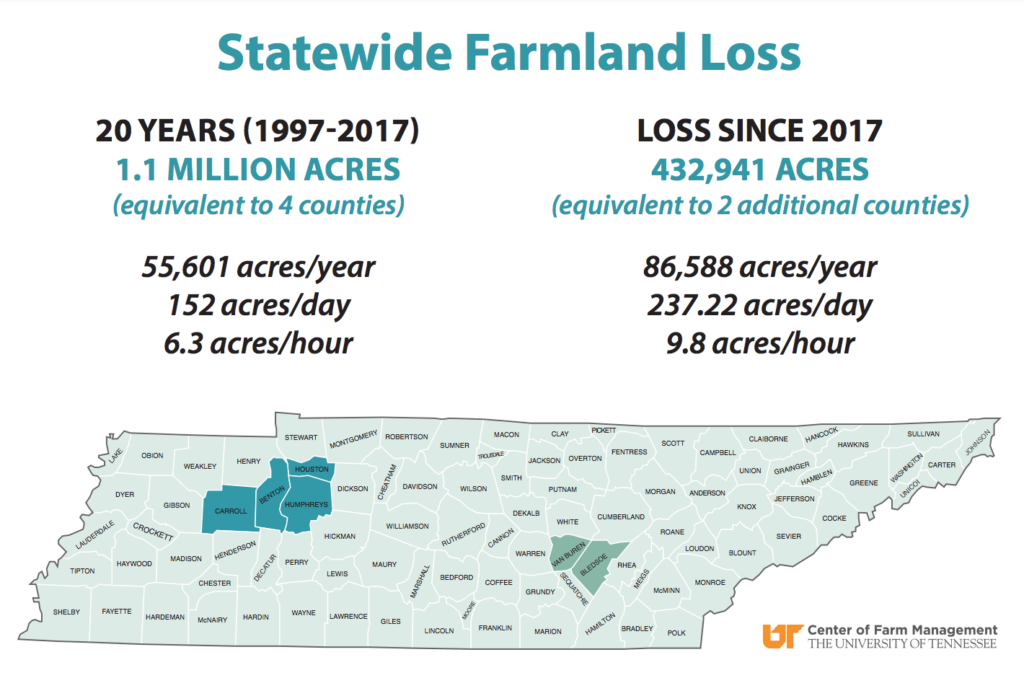
WATCH: UTIA Presents on TN Farmland Loss at TFBF Annual Convention
Crop Protection
The United States Supreme Court has released its decision on Monsanto v. Durnell, a case which will heavily affect how farmers across the nation can oversee and manage their farmland and crops. The case centers around the conflict between federal regulation and state failure-to-warn laws.

While the Environmental Protection Agency does not currently have specific warnings regarding many chemicals such as those containing glyphosate, many states have attempted to pass legislation restricting these products. The question is whether these actions are overruled by federal regulation under the Federal Insecticide, Fungicide, and Rodenticide Act (FIFRA). The court ruled that state “failure to warn” regulations do not preempt FIFRA.
The decision in Monsanto v. Durnell provides the security and freedom farmers need to manage their operations. Farm Bureau believes products which have undergone proper approval processes under FIFRA should be protected from lawsuits making unsubstantiated health or safety claims. Farm Bureau will continue to support farmers as federal and state conversations around liability protections continue.
Tennessee Agricultural Enhancement Program
- The Tennessee Agricultural Enhancement Program provides cost share dollars to agricultural producers and allows producers to maximize farm profits, adapt to changing market situations, improve operation safety, increase farm efficiency, and make a positive economic impact in their communities.
- More than $309 million has been invested in 97,855 producer projects from 2005 through 2025. Each TAEP dollar generates $6.55 in local economies.
- New application materials are available in mid-August. The annual application period is October 1st-7th. The application has moved completely online, and paper versions are no longer provided.
- Approval notifications are scheduled to be sent in mid-December. Program purchases can be made starting October 1st and must be completed by the program’s final reimbursement request deadline.

Agricultural Enterprise Fund (AEF)
The Agricultural Enterprise Fund (AEF) is an incentive program which awards grants to those starting or growing their agricultural, food, and forestry enterprises. Businesses, nonprofits, local governments, or other entities in Tennessee are considered. For every dollar the state awards to an eligible business, $17.55 is generated in the local economy.
Applicants must demonstrate a strong potential for an impact on local farm income, access to markets, increased capacity, or agricultural innovation within the state of Tennessee. Priority is given to those located in at-risk counties, distressed counties, and counties near those at-risk or distressed.
The application is due in the month of July every year.
Agricultural Enterprise Fund- Tennessee Department of Agriculture
Historic Investment for 4-H and FFA | Tennessee Farm Bureau
4-H and FFA are two of the premier youth development organizations in Tennessee that develop young leaders in agriculture. Farm Bureau, through giving, collaboration with Farm Bureau’s YF&R programs, and advocacy, supports the missions of these organizations.
In 2024, Farm Bureau worked with 4-H and FFA to advocate for and secure $90.5 million in state funding towards enhancements to their respective camping centers. 4-H and FFA members from all 95 counties utilize these camps and centers each year. Thousands of parents and families entrust these organizations to positively impact the lives of their children. 178,000 youth are directly engaged with either 4-H or FFA, and 81% of those students say attending camp makes them more likely to pursue a post-secondary education. Investing in facilities such as these which directly contribute to student success is not only a short-term investment for Tennessee’s education climate, but a direct investment into the state’s future workforce.
Farm Bureau is proud to support continued funding for new state projects that support 4-H, FFA, and the future of agriculture.
Learn More About 4-H and FFA Programs:
Deer – Economic Damages
Rising deer populations across the state have heavily disrupted Tennessee farm operations. Deer populations have caused extreme economic damage to both large and small farms across the state, and Farm Bureau is committed to seeing this costly issue addressed. A recent study from the University of Tennessee Institute of Agriculture provides research into the statistical impact of deer on Tennessee agriculture.
On top of agricultural damages, vehicular deer collisions cost Tennessee Farm Bureau members around $70 million each year. Farm Bureau encourages continued action to contain the damages created by deer and other wildlife.
Deer – Chronic Wasting Disease (CWD)
The Tennessee Wildlife Resource Agency (TWRA), after reviewing changes in regulation created by the Tennessee General Assembly, has created a new permitting process allowing hunters to bait deer under specific guidelines. The most important guideline is regarding “chronic wasting disease areas”, where baiting will not be allowed. These regulations take effect August 1, 2026.
The TWRA is also currently operating larger projects and regulations to combat Chronic Wasting Disease (CWD). West Tennesseans should particularly take note of these regulations, as the majority of counties west of the Tennessee River are currently being designated as management areas. Tennessee Farm Bureau continues to monitor this situation and its impact on both farmers and hunters.
Regulations & Hunting with CWD | TWRA | Tennessee Wildlife Resources Agency
Wild Hog Eradication
A study of 1620 landowners and farmers conducted by the TWRA found that over $28 million in damages had been caused in 2015 alone by wild hogs. Today, that damage continues to be monitored to ensure that wild hogs do not hinder farmers across the state.
While wild hog hunting is heavily regulated in the state, TWRA provides helpful information on current regulations to limit hog populations. TWRA also operates the Wild Hog Eradication Action Team (WHEAT) to continue to help limit these damages.
Black Vultures
Black Vultures have been a consistent cause of damage for farmers across the nation due to their predatory nature. Currently, regulations under the Migratory Bird Treaty Act requires farmers to obtain a federal permit to be able to manage these birds. Farmers should insure compliance with these guidelines and utilize local educational resources on how best to manage these predators.
Multiple pieces of federal legislation have been considered to provide an exemption for Black Vulture management. This includes the Black Vulture Relief Act of 2025, which would allow farmers to eliminate birds which pose an immediate danger to farm animals. The act was passed through the House Natural Resources Committee and placed on the House Calendar but failed to be pushed further. Farm Bureau is committed to providing farmers with the freedom needed to effectively manage their operations.
The Tennessee Farm Bureau Federation (TFBF) Board of Directors annually obtains a statewide depredation permit for black vultures from the United States Fish and Wildlife Service (USFWS). This service has provided an added benefit for members since 2016 and allows livestock owners to address issues as needed.
The TFBF statewide depredation permit allows Farm Bureau members who are livestock producers to apply for a livestock protection depredation sub-permit, allowing legal “takes” of black vultures attacking livestock. TFBF administers the statewide permit at no cost to TFBF members who apply for a livestock protection depredation sub-permit.
Learn More About Black Vulture Permits | Tennessee Farm Bureau
Infrastructure
WATCH: TFBF Sits Down with USDA Rural Development State Director Patrick Jaynes to Discuss Rural Development and Infrastructure
Broadband
Tennessee has been on the forefront of broadband investment for the benefit of citizens across the Volunteer State. Broadband infrastructure provides Tennesseans with needed connectivity online to better collaborate and communicate with businesses, community partners, and friends and family. Farmers benefit from these developments as precision agriculture projects continue to expand and the need for advanced tools in the hands of farmers grows. Having strong connectivity provides farmers with reliable new tools that support their existing operations.
The Tennessee Department of Economic and Community Development announced in 2026 that $200 million would be directed towards broadband infrastructure. Projects such as these support growth and innovation across Tennessee.
Bungie Road
Located in Dyer County, Bungie Road serves as the main connection point between many Tennessee farmers and larger markets, both domestic and international, through its location next to the Mississippi River. In recent years, the road has continually faced closures and disruptions from flooding, shutting down needed connection between buyers and sellers and dramatically affecting Tennessee farmers’ livelihoods.
Farm Bureau, alongside other Tennessee industry partners, hope to see new state funding to redevelop the Bungie Road route to better support the need of the area’s commodity exports. Farm Bureau recently sent a letter to Commissioner Holt regarding these concerns and the desire for greater state support.
Read TFBF’s Letter to Commissioner Holt Regarding Bungie Road
Short-Line Rail
Short-line rail has long served as a vital connection between Tennessee farmers and larger market areas. The agriculture industry is the third largest beneficiary of short-line rail infrastructure in Tennessee. The 2021 Tennessee State Budget provided a one-time funding allocation towards short-line rail infrastructure. This funding was instrumental in continuing to support vital projects across the state. However, recurring funding towards these initiatives would help expand and secure these projects to better support the needs of expanding commodity markets.
Read Farm Bureau’s letter to Governor Lee regarding short-line rail funding below.
TFBF’s Letter to Governor Lee Urging Allocation of Recurring Funding for Short-Line Rail
The Tennessee Department of Agriculture (TDA) provides numerous grant and incentive programs which assist farmers in developing the total uses and productivity of both their operations and their farmland. The TDA website provides further details as well as links to the following applications.
AgTrack
AgTrack provides funds to starting farms/operations which focus on value-added projects which “benefit other producers or forest landowners.” The minimum capital expenditure for the program is $2 million with a reimbursement of $1 million.
Value-Added
The Tennessee Agricultural Enhancement Program (TAEP) includes specific cost-share programs for “Value-Added Producers.” This cost share includes up to 50% reimbursements of costs related to program items. The maximum reimbursement value is $12000.
Center for Profitable Agriculture
Tennessee Farm Bureau continues to have an incredible partnership with the Center for Profitable Agriculture at the University of Tennessee Institute of Agriculture. The goal of CPA is to provide educational programs and technical assistance to Tennessee farmers interested in value-added enterprises to improve farm income. CPA specializes in helping farm families and entrepreneurs with:
- Value-added financial analysis and development including cost-analysis, breakeven analysis, and profit/loss analysis,
- Value-added market analysis and development including target market identification, sales estimates, and pricing and promotion strategies and,
- Value-added technical analysis including product development, packaging, labeling, and regulations.
Learn More About the Center for Profitable Agriculture and Value-Added Agriculture with UTIA
Conservation is about more than maintaining the land and natural resources Tennessee farmers utilize each day. Precision agriculture techniques, crop rotation, no-till agriculture, and sustainable practices ensure that farmers in Tennessee continue to have the security and tools to provide for themselves, their families, and their communities for years to come.
Multiple programs in Tennessee currently support sustainability initiatives. With the passage of the Farmland Preservation Act of 2025, Tennessee landowners will be able to ensure that their lands are preserved for future generations through voluntary easements. TN Sustainable Agriculture Research and Education (SARE) through UTIA’s Center for Profitable Agriculture provides education and grants related to sustainable agriculture. The Tennessee Department of Agriculture (TDA) operates the Land and Water Stewardship Section to assist Tennesseans in using best management practices.
Learn more about conservation in Tennessee through the following resources:
TN SARE | Center for Profitable Agriculture
Land and Water Stewardship – Farms – Department of Agriculture – TN.gov
Feeding the World, Ensuring the Future | Tennessee Farm Bureau
Tennessee State Fact Sheet – TN SARE
Emerging food and agricultural technologies create unique challenges in labeling everyday food products. The growth of lab-cultivated meat products and other biotechnologies has caused concern amongst consumers and farmers. On top of this, concerns around processing practices and food safety remain among the public.
Tennessee Farm Bureau is committed to transparency in food labeling through federal, not state-by-state, regulatory frameworks. Regulations should be based on concrete scientific research, providing consumers with knowledge about market products.
The Tennessee Farm Bureau Federation, alongside American Farm Bureau Federation, signed on to a coalition letter to support science-based regulations that will provide necessary consumer protections while maintaining the production freedoms farmers need to provide the nation with a healthy food source.
Coalition letter regarding Science and Risk-based Regulations – NASDA
In 2025, the UT Institute for Public Service was awarded $2 million towards projects that will support local planning resources across Tennessee. This fund will assist with planning, infrastructure, zoning, and other important local projects. The original intent of the funding request came after a partnership between Tennessee Farm Bureau, TDA, UTIA, IPS, TDECD, TCSA, TML, and ACM for farmland preservation across the state. As this initiative becomes operational, Farm Bureau looks to support the important work of rural and farmland preservation.
State Funds Local Planning Agency at UT Institute for Public Service | Institute for Public Service
Precision Agriculture Expertise at UTIA
The University of Tennessee Institute of Agriculture is seeking a $3M recurring investment to support the expansion of precision agriculture expertise by creating the Tennessee Center for Agricultural Innovation (CAI). The center will play a pivotal role in advancing agricultural technology and enhancing the vitality of Tennessee’s agricultural sector. The CAI team will focus on critical areas, including artificial intelligence, data science, sensors/sensing technologies, precision animal nutrition, cybersecurity, and livestock housing environments. By investing in these technologies, UTIA aims to not only bolster research capabilities, but also to equip our farmers with innovative tools to optimize land use efficiency and mitigate the impacts of farmland loss.
The Center for Agricultural Innovation has been approved by the UT System as a state funding request, and it now awaits approval and addition to the Tennessee State budget. Farm Bureau is committed to seeing this project created to see continued innovation and development in Tennessee agriculture.
Tennessee Farm Bureau Federation Vice President James Haskew represents Farm Bureau with TVA partners, as he currently serves TVA Regional Resource Stewardship Council and the TVA External Landowner Task Force. Farm Bureau is thankful for Vice President Haskew and TVA as they work together to consider how energy and flood management conversations impact Tennessee farmers.
Flood Management
TVA has large-scale infrastructure and numerous tools to ensure not only farmers, but all of Tennessee is protected from flood damage. Numerous flood reservoirs exist across the state to protect flood-prone areas including those such as Chattanooga, Knoxville, Shelbyville, etc. TVA also runs flood simulations to determine the best response practices in affected areas and how to best manage dams and reservoirs to avoid these disasters. All of this is managed through the River Forecast Center in Knoxville, which is used to monitor weather conditions to ensure that TVA resources are managed to avoid floods in Tennessee.
Learn More About TVA Flood Management
Energy Production
TVA infrastructure provides over 40,000 megawatts of energy production to those in Tennessee and beyond, providing rural Tennesseans with the energy needed to power both their homes and farms. Over 10 million customers, through TVA’s energy and electric cooperative partners, are supported by TVA infrastructure. In total, TVA manages 72 energy production facilities with more currently in development. Farm Bureau is committed to seeing rural Tennesseans continue to be provided with the energy needed to support their livelihoods and works with the TVA to achieve this goal.
WATCH: Farm Bureau Sits Down with TVA VP Scott Turnbow to Discuss Rural Energy and Agriculture
Solar
Government and private industry should work together in Tennessee to develop the market in new areas and develop methods by which supplies may be fed into the total energy supply system and made available to our citizens. Placement of new energy sources should prioritize lands not suitable for production agriculture. While new energy resources are important, long-term availability of land for food and fiber production should take precedence. We support upgrading and protecting the electric grid infrastructure to ensure security, reliability, and survivability. We support state legislative efforts enabling increased use of new energy sources while protecting property rights and agricultural endeavors, markets, and infrastructure.
TVA supports solar energy production in their facilities through three programs, each focused on different aspects of the energy production supply chain. Green Power Providers (GPP) allows local businesses to set up solar panels and sell excess energy back to the TVA. The Solar Solutions Initiative operates as large-scale energy infrastructure creation, as TVA works with larger entities to create solar structures that power TVA grids. Lastly, EnergyRight focuses more specifically on financing and rebate structures.
TVA also provides a “Solar Calculator” to consumers to help estimate solar production for those considering installing solar panels.
More information on TVA’s solar initiatives on the TVA website and at the following page from the Tennessee Solar Initiative:
Tennessee Valley Authority Solar Programs | Tennessee Solar Authority
Tennessee Valley Farmers
Tennessee Farm Bureau is supportive of the work of Tennessee Valley Farmers, a group of farmers and landowners who advocate for sound management practices at TVA to mitigate flooding on farmland.
Walking Horse shows are the most regulated equestrian sport in the country. All horses shown are inspected by U.S. Department of Agriculture-approved organizations, and the industry has 99% compliance rate. In 2025 alone, there were around 40,000 inspections made for nearly 200 competitions, and despite this, Walking Horse Shows are one of the few sports with universal inspection of all participants.
Owners and trainers do often use “packages” (padded or built-up shoes) during show season to enhance their natural gait, but nothing that hurts the animal. Tennessee Walking Horses use a six-ounce action device at heaviest, which is equivalent to around 0.04% body weight. Numerous studies including those conducted at the University of Tennessee have concluded that pads and action devices do not cause soring or harm when used correctly. Soring is illegal under the federal Horse Protection Act, and Tennessee Farm Bureau absolutely does not support or promote this practice. Farm Bureau is committed to the safety and security of farm and sport animals and protecting agricultural industries that support Tennesseans across the state.
iFarm.iVote. Because Rural Votes Matter.
iFarm.iVote. is a program of Tennessee Farm Bureau with the purpose of engaging farmers across Tennessee with their local, state, and federal government. Agriculture is Tennessee’s number one industry and truly, America’s most important industry. It is the lifeblood to rural communities across the Volunteer state, and as a result, rural votes matter. The voices of our rural communities need to be heard on all levels of government.
iFarm.iVote. Resources: