*In accordance with the White House memo, Regulatory Freeze Pending Review, USDA has suspended the processing and payments under the Coronavirus Food Assistance Program – Additional Assistance and has halted implementation until further notice. FSA local offices will continue to accept applications during the evaluation period.
In the coming days, USDA and the Biden Administration intend to take additional steps to bring relief and support to all parts of food and agriculture during the coronavirus pandemic, including by ensuring producers have access to the capital, risk management tools, disaster assistance, and other federal resources. Check with your FSA office or this link for more information from USDA.
in accordance with the White House memo, Regulatory Freeze Pending Review, USDA has suspended the processing and payments under the Coronavirus Food Assistance Program – Additional Assistance and has halted implementation until further notice. FSA local offices will continue to accept applications during the evaluation period.
In the coming days, USDA and the Biden Administration intend to take additional steps to bring relief and support to all parts of food and agriculture during the coronavirus pandemic, including by ensuring producers have access to the capital, risk management tools, disaster assistance, and other federal resources. Check with your FSA office or this link for more information from USDA.
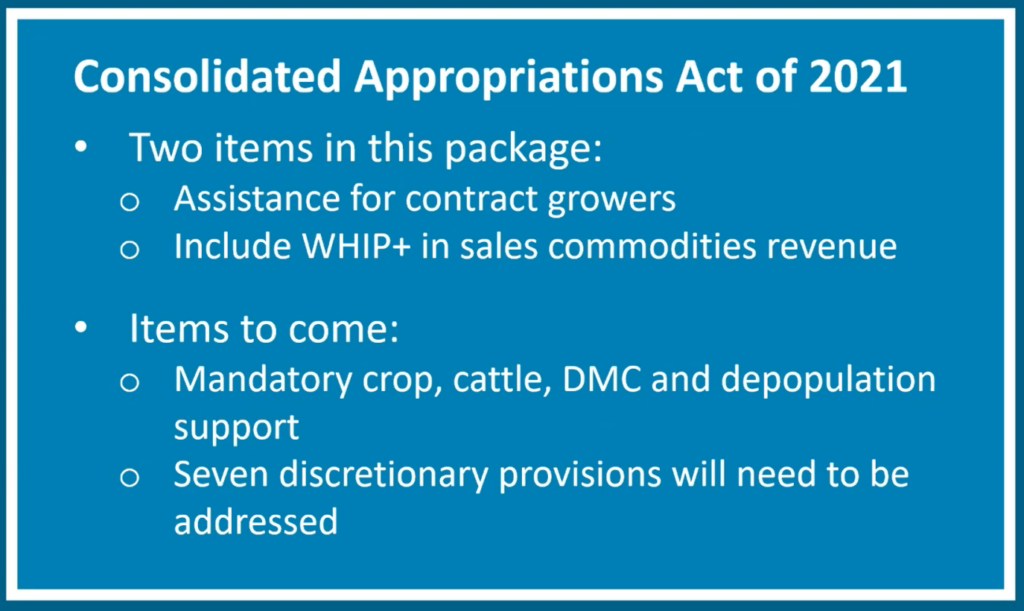
Washington, D.C. – U.S. Secretary of Agriculture Sonny Perdue announced the U.S. Department of Agriculture (USDA) will provide additional assistance through the Coronavirus Food Assistance Program (CFAP), expanding eligibility for some agricultural producers and commodities as well as updating payments to accurately compensate some producers who already applied for the program. Producers who are now eligible and those who need to modify existing applications due to these updates can contact USDA’s Farm Service Agency (FSA) between Jan. 19 and Feb. 26. Some of these changes are being made to align with the recently enacted Consolidated Appropriations Act of 2021 while others are discretionary changes being made in response to ongoing evaluation of CFAP.
“The COVID-19 pandemic has left a deep impact on the farm economy, and we are utilizing the tools and monies available to ease some of the financial burdens on American producers to ensure our agricultural economy remains strong, independent and a global leader in production,” said Secretary Perdue. “As part of implementing CFAP 1 and CFAP 2, we identified new areas of support and Congress recently directed us to provide additional relief. This additional assistance builds on to the $23.6 billion in assistance already provided to our farmers and ranchers impacted by the pandemic, and we will continue to implement other provisions enacted by Congress.”

Expanded Eligibility for CFAP 2
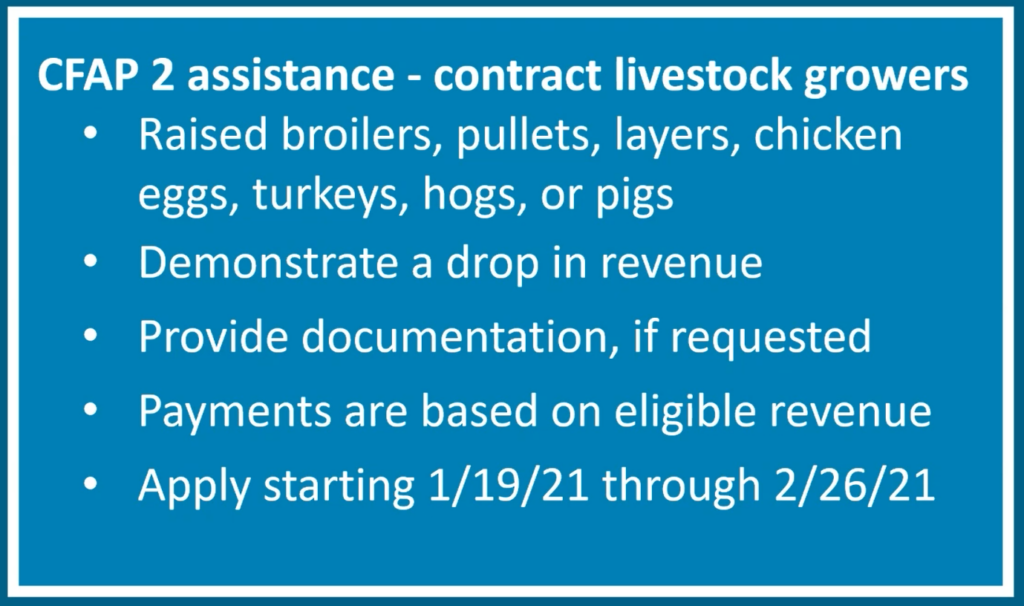
Contract producers of swine, broilers, laying hens, chicken eggs and turkeys who suffered a drop in revenue in 2020 as compared to their 2019 revenue because of the pandemic now are eligible for assistance. Producers could receive up to 80% of their revenue loss, subject to the availability of funds.
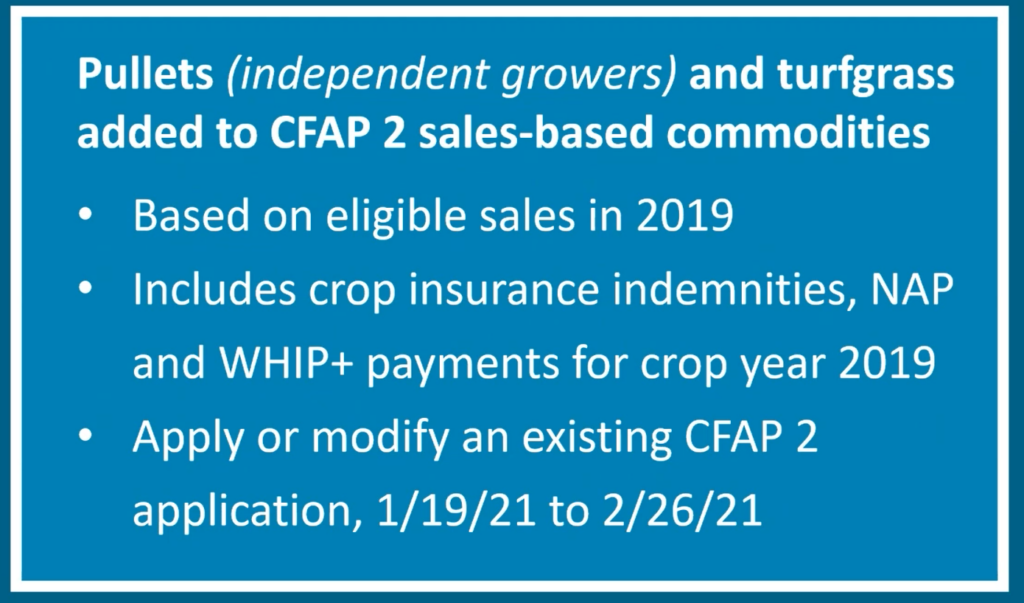
Producers of pullets and turfgrass sod also now are eligible for CFAP payments. The commodities were not explicitly included in the initial CFAP 2 rule. Payments are based on eligible sales, and the payment calculation in the updated rule includes crop insurance indemnities, Noninsured Crop Disaster Assistance Program (NAP), and Wildfire and Hurricane Indemnity Program – Plus (WHIP+) payments.
On January 15, USDA announced additional assistance through the Coronavirus Food Assistance Program. This new assistance will include expanded eligibility for certain commodities and producers established in the recently passed relief package, as well as updated payments for producers who were eligible under previous iterations of the program. Producers have from January 19 through February 26 to submit new applications or modify existing applications if they have participated in the program already.


Updated Payment Calculations for CFAP2 and CFAP1
Along with the additional assistance, the Farm Service Agency adjusted the payment calculation to use the 2019 calendar year sales and 2019 crop insurance indemnities, Noninsured Crop Disaster Assistance Program and Wildfire and Hurricane Indemnity-Plus payments, multiplied by the applicable payment rate for sales commodities. In the CFAP2 program, the sales commodities included specialty crops, aquaculture, tobacco, specialty livestock, nursery crops and floriculture.
FSA also adjusted the CFAP2 payment calculation for certain row crops, addressing an issue that existed for producers who had crop insurance coverage but did not have a 2020 Actual Production History-approved yield. Now, when APH is not available, FSA will use 100% of the 2019 Agriculture Risk Coverage-County benchmark yield to calculate payments instead of the 85% the earlier CFAP2 calculations required. This change only covers producers with crop insurance coverage who grow barley, corn, sorghum, soybeans, sunflowers, upland cotton and wheat.
Swine producers who participated in CFAP1 will be receiving an automatic “top-up” payment of $17 per head, increasing the total CFAP1 inventory payment to $34 per head. Payment rates for swine are increasing from 25% to 50%of the estimated total economic loss. This top-up payment aims to rectify large differences between first quarter sales loss rates and inventory payment rates for CFAP1 payments, which were based on expected sales in the second and third quarters. There is no action required by producers to receive these additional payments. Producers who did not submit an approved CFAP1 application are not eligible.
Newly Eligible Commodities and Producers
Many producers were left out of the CARES Act and subsequent CFAP programs because farmers who raise animals under a contract for another entity that owns the animals could not participate. Poultry, in particular, was left out of the CARES Act, largely due to the structure of the industry and how the relationship between the farmer and integrator operates. Typically, a broiler farmer raises and cares for the birds, but the integrator maintains ownership of them. However, these producers saw their income significantly reduced as many of their barns (which they financed the construction of and still were required to service the debt on) remained empty due to supply chain disruptions earlier in the pandemic. The impacts to contract growers could arise from a variety of conditions, including: delayed delivery of young poultry and hogs to contract producers, decreased housing densities, additional costs for keeping animals longer than typical durations, and damage caused by animals too large for housing.
On Friday, USDA clarified that contract producers of broilers, turkeys, chicken eggs, laying hens and hogs who suffered a drop in revenue in 2020 due to the pandemic are now eligible for assistance. Payments are based on eligible revenue for January 1, 2020, through December 27, 2020, minus eligible revenue for January 1, 2019, through December 27, 2019, multiplied by up to 80%, subject to availability of funds. Additionally, producers of pullets and turfgrass sod are also now eligible for CFAP payments. These commodities were not explicitly included in the original CFAP2 rule, but their payment structure will be similar to sales commodities and the payment rate will vary based on their overall sales. For example, if we look at Figure 2, a pullet producer with less than $50,000 in sales would receive a payment rate of 10.6% of those total sales. Figure 2 also shows the expected total payments to each sector of contract growers as calculated in USDA’s cost-benefit analysis of the rule. While the analysis does not show any payments for turkeys, this does not mean that producers are ineligible. In this analysis, USDA is examining the industries in aggregate, and as a result, estimates the aggregate industries’ revenue did not suffer a loss. Individual producers who can show that they suffered a decline in revenue from 2019 to 2020 are certainly eligible and should apply for the program.


Of the $2.3 billion in additional CFAP support, USDA’s cost-benefit analysis estimates that contract poultry producers will receive approximately $1.5 billion in CFAP support. Following poultry, contract hog producers are expected to receive $479 million, and top-up inventory payments for swine producers are expected to total $150 million. Combined, contract poultry, contract hog, and swine inventory payments are expected to total nearly $2.1 billion, approximately 91% of these new additional resources.


How to Apply
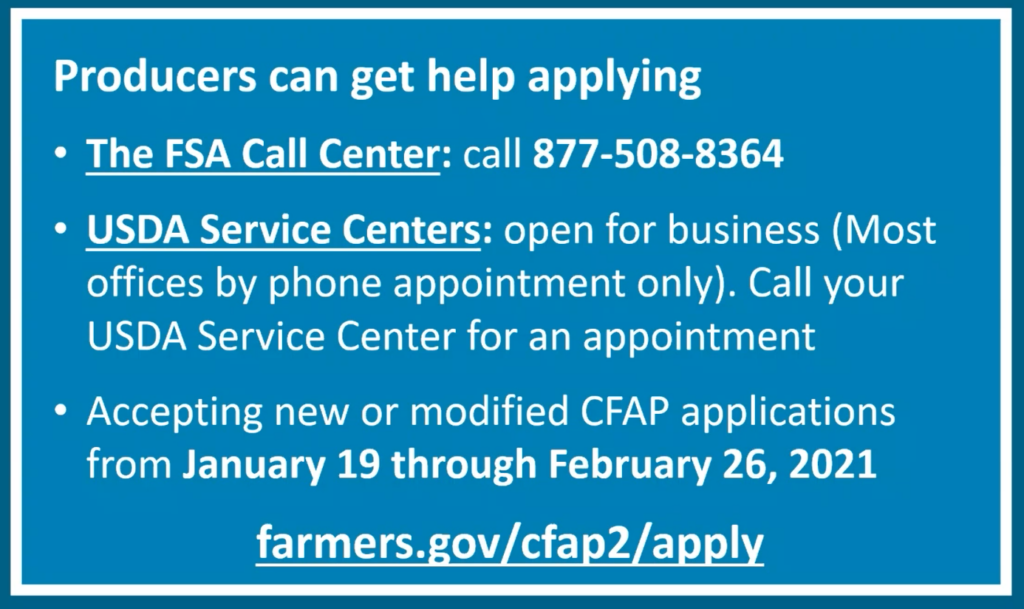
Newly eligible producers who need to submit a CFAP2 application or producers who need to modify an existing one can do so between January 19 and February 26, 2021. Producers who are modifying their applications should contact their local USDA Service Center for assistance. Producers who are filing new applications should contact their Service Center or call 877-508-8364 for one-on-one support. Additional information can be found on USDA’s CFAP website.
Similarly, FSA adjusted the payment calculation to use the producer’s eligible 2019 calendar year sales, and 2019 crop insurance indemnities, NAP, and WHIP+ payments, multiplied by the applicable payment rate for all sales commodities, which include specialty crops, aquaculture, tobacco, specialty livestock, nursery crops and floriculture, for CFAP 2. Producers who applied during the sign-up period that closed Dec. 11, 2020, can modify an existing CFAP 2 application between Jan. 19 and Feb. 26, 2021.
Additionally, FSA adjusted the payment calculation for certain row crops for CFAP 2, specifically those for which a producer had crop insurance coverage but not an available 2020 Actual Production History (APH) approved yield. FSA is now using 100% of the 2019 Agriculture Risk Coverage-County Option (ARC-CO) benchmark yield to calculate payments when an APH is not available rather than 85%, which was in the original CFAP 2 calculations. This calculation change is only for producers with crop insurance coverage who grow barley, corn, sorghum, soybeans, sunflowers, upland cotton and wheat. Producers who applied during the sign-up period that closed Dec. 11, 2020, can modify an existing CFAP 2 application between Jan. 19 and Feb. 26, 2021.


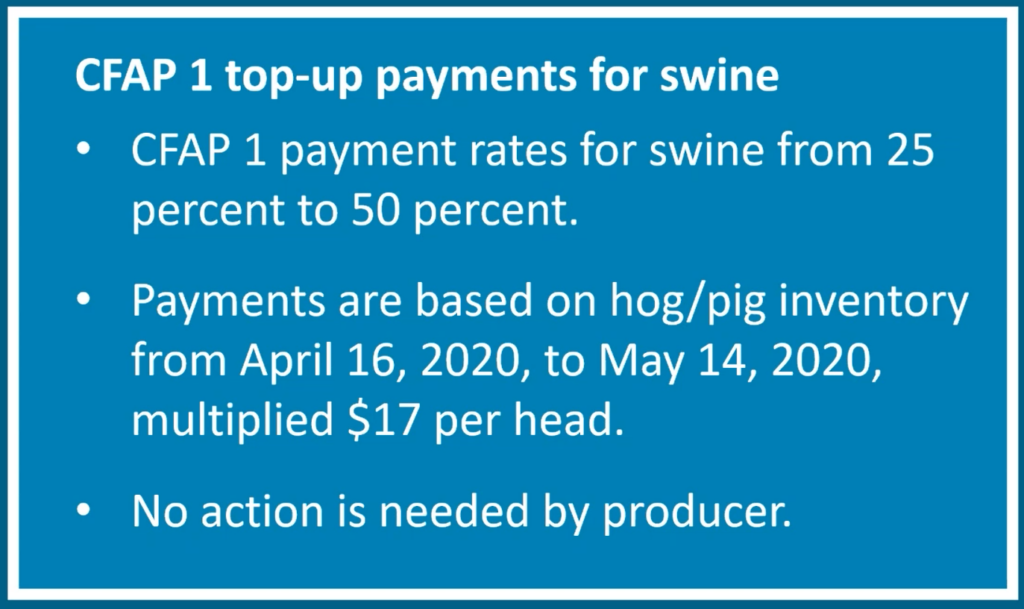
FSA is providing an additional CFAP 1 inventory payment for swine to help producers who face continuing market disruptions from changes in U.S. meat consumption due to the pandemic. Swine producers with approved CFAP 1 applications will soon automatically receive a “top-up” payment of $17 per head increasing the total CFAP1 inventory payment to $34 per head.
Newly eligible producers who need to submit a CFAP 2 application or producers who need to modify an existing one can do so between Jan. 19 and Feb. 26, 2021, by contacting their local USDA Service Center. New applicants can also obtain one-on-one support with applications by calling 877-508-8364.
In addition to the changes being made to CFAP, per language in the Consolidated Appropriations Act of 2021, FSA will extend 2020 Marketing Assistance Loans to provide additional flexibilities for farmers. FSA is also preparing to move forward on implementation of the remaining provisions of the recently passed Consolidated Appropriations Act of 2021.
To learn more about this additional assistance, visit farmers.gov/cfap.